A paradigm shift toward decentralized healthcare is essential to reduce the burden on hospital-centered care and to enable more accessible, efficient, and personalized diagnostics through portable point-of-care technologies. The increasing demand for chronic disease management, early diagnosis, and precision medicine requires continuous, real-time, and non-invasive access to biochemical information – capabilities that current clinical and wearable technologies still struggle to provide at scale. While wearable electronics have made significant progress in monitoring physical parameters such as heart rate, temperature, and motion, many of the most valuable indicators of health and disease are biochemical markers, including ions, metabolites, proteins, and nucleic acids found in blood, sweat, saliva, and interstitial fluid.
Our approach
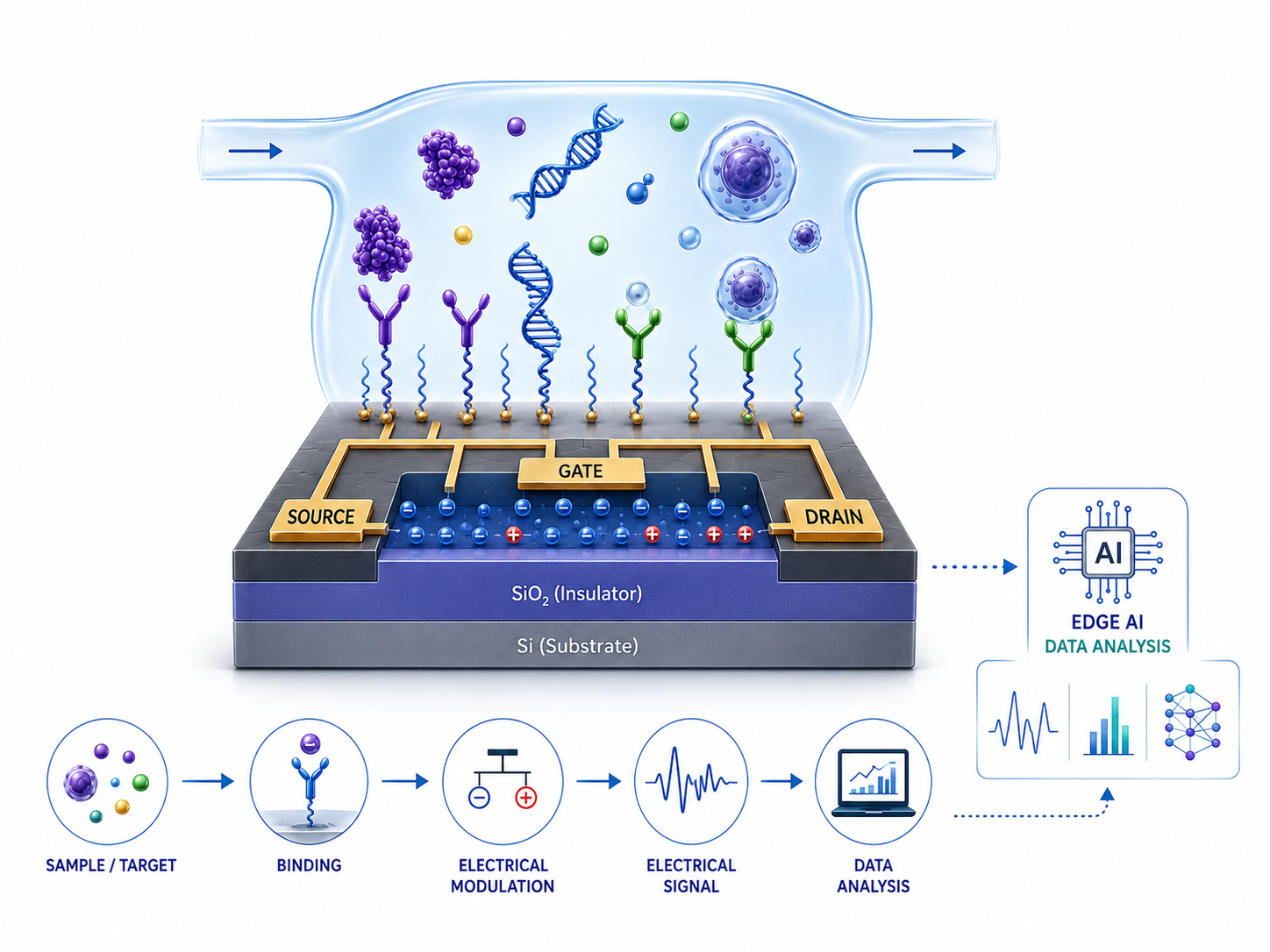
Our research addresses this challenge by developing next-generation semiconductor technologies for scalable biosensing platforms, including large sensor arrays based on one- and two-dimensional materials, optoacoustic devices, microfluidics channels, and More-than-Moore architectures. By combining advanced semiconductor manufacturing processes, optimized chip architectures for conventional and neuromorphic sensing, and edge-AI-enabled data analytics, we aim to enable a new generation of portable point-of-care technologies for continuous health monitoring and personalized medicine with clinical-grade relevance.
Collaborators
Our research is conducted within the MIT program for Health Sciences and Semiconductors, involving several academic and industrial partners.